

Founder-led sales works.
Until it doesn’t.
I’ve seen this pattern across hundreds of founder conversations, and it shows up almost the same way every time.
Early deals close.
Customers sign.
Revenue shows up.
Founders take this as proof:
“We have product-market fit.”
Most of the time, they don’t.
They have a magician.
The magician problem

Many founders are exceptional closers.
Not because the process is great.
Not because the messaging is tight.
Not because the system works.
They close through:
Force of personality
Founder credibility
Personal urgency
Existing relationships
Willpower
That’s magic.
And magic doesn’t scale.
Why this creates fake product-market fit
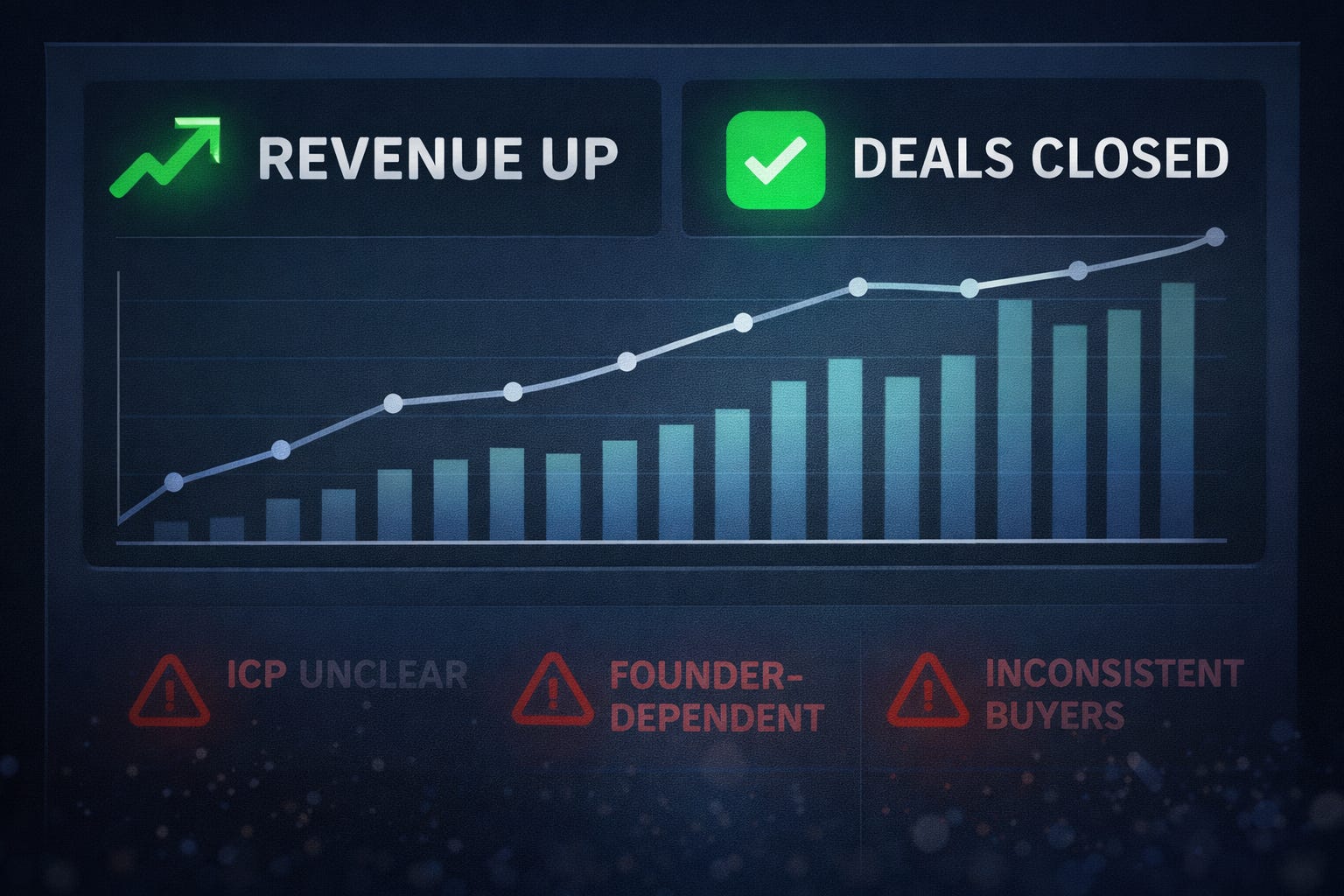
When a founder closes deals this way, three dangerous things happen.
1. The signal gets distorted
Deals are closing, but not because:
The ICP is clear
The problem is consistently framed
The value is repeatable
They’re closing because the founder is in the room.
That’s not market validation.
That’s personal leverage.
2. The system never gets built
Founders skip:
Tight discovery
Clear qualification
Repeatable messaging
Defined exit criteria
Why?
Because they don’t need it yet.
The magician keeps winning without a map.
3. The business mistakes momentum for readiness
Revenue shows up.
Investors get excited.
Hiring begins.
The assumption becomes:
“If the founder can sell it, a salesperson can too.”
That assumption is wrong more often than it’s right.
Enter the first sales hire

This is where things break.
The founder hires an AE and hands them:
A product
A loose pitch
A few recorded calls
And says:
“Go do what I was doing.”
But the AE doesn’t have:
Founder authority
Founder relationships
Founder tolerance for chaos
They have a quota.
Now deals stall.
Demos fall flat.
Confidence drops.
Founders conclude:
“We hired the wrong person.”
Most of the time, they didn’t.
They hired someone into a non-existent system.
Magicians vs. soldiers

Magicians
Win through instinct
Break rules and still close
Can’t explain why something worked
Are impossible to copy
Soldiers
Follow process
Execute consistently
Improve through repetition
Scale organizations
You build companies with soldiers.
Magicians can help early.
They cannot be the foundation.
Why founders resist systemizing
Systemization feels slower.
It forces:
Discipline
Tradeoffs
Saying no to bad deals
Letting some revenue walk
Founders tell themselves:
“We’ll clean it up later.”
Later never comes.
By the time it hurts, the damage is already done.
The hidden cost of founder heroics
Founder-led sales often creates:
Inconsistent ICP
Custom everything
Feature-driven demos
One-off deals
Fragile pipelines
And worst of all:
Founders stay trapped in sales longer than they should.
Not because they want to.
Because they have to.
What actually scales
Real scale starts when founders shift roles.
From:
“I close deals.”
To:
“I design how deals get closed.”
That means:
Clear ICP definition
Structured discovery
Repeatable messaging
Defined success criteria
A system someone else can run
The founder doesn’t disappear.
They become the architect, not the hero.
Final thought
Founder-led sales is not the enemy.
Founder-dependent sales is.
If deals only close when the founder is involved, you don’t have product-market fit.
You have a magician.
And magicians make terrible foundations for scale.
---
**If you liked this, you might also like:**
→ Why Founder Led Sales Stops Working and How to Fix the Sales Conversation Itself
→ The First Sales Hire Almost Always Fails for the Same Reason
→ Founder-Led Sales: What It Is, When It Works, When It Breaks
One of the more powerful lessons you taught me as a sales leader
Strong metaphors that describe exactly how founders & seller differ.