


Stop confusing a busy calendar with a healthy pipeline and start measuring the movement that actually closes deals.
You are staring at a CRM filled with ‘qualified’ opportunities, yet your revenue hasn’t budged in three months. Your calendar is a sea of blue blocks, and your Slack is buzzing with ‘great demo’ updates from your founding AEs. On paper, you are doing everything right. In reality, you are caught in the activity trap. According to a 2025 report from SalesSo, pipeline generation is up 23% across the industry, but win rates have plummeted by 18%. This is the Pipeline Paradox: we are doing more work to get fewer results. For a B2B SaaS founder, the difference between activity and progress is the difference between scaling and stalling out in the ‘maybe’ zone.
The Calendar Fallacy and the Cost of Busy Work
The most dangerous metric in an early-stage startup is the number of meetings on a founder’s calendar. It feels like momentum. It looks like growth. But for many, it is just expensive noise. When you are in the trenches of founder-led sales, it is easy to equate effort with outcome. You sent 500 personalized emails this week? Great. You held 15 discovery calls? Fantastic. But if those 15 calls resulted in 15 ‘send me some more info’ responses, you haven’t made progress. You have just successfully scheduled your way into a dead end.
A 2025 Optifai Sales Ops Benchmark found that B2B sales cycles have lengthened by 22% since 2022. This isn’t just because buyers are more cautious; it is because sellers are filling the gap with low-value activity. We see this constantly in our SPRINT framework audits: teams that prioritize ‘touchpoints’ over ‘truth-seeking.
If your sales process is built on a checklist of tasks rather than a series of buyer commitments, you are running a marathon on a treadmill. You are exhausted, but you are still in the same place you started.Activity: Sending a follow-up email to ‘check in’ on a proposal.Progress: Receiving a redlined contract from the prospect’s legal team.Activity: Performing a second demo for a different department.Progress: Getting the CFO to join a 15-minute ROI validation call.
The cost of this busy work is higher than just lost time. It creates a false sense of security that prevents you from making the hard pivots necessary for product-market fit. If you think your pipeline is worth $2M based on activity, you won’t feel the urgency to fix your messaging or target a different ICP until it’s too late and the cash is gone.
Signal vs Noise: Identifying the Real Movement
In the early stages of a pipeline, noise is everywhere. Prospects are polite. They like to see new tech. They will take a demo because it’s easier than saying no. This ‘polite interest’ is the ultimate noise. To scale, you must develop an ear for signal. Signal is any action taken by the buyer that requires them to expend internal social capital or time. If they aren’t willing to do the work, they aren’t going to buy.
Gartner’s 2025 research indicates that 75% of B2B buyers prefer a rep-free experience for the majority of their journey. When they do engage with you, they aren’t looking for a pitch; they are looking for a consultant to help them navigate their own internal mess. Signal, therefore, is often found in the complexity of their questions rather than the frequency of their replies. A prospect asking about your SOC 2 compliance or your API documentation is a much stronger signal than a prospect saying ‘this looks really cool.
Consider the difference in these two scenarios:The Noise Scenario: You have three meetings with a champion who loves the product. They tell you they are ‘socializing it’ internally. They respond to every email within an hour. They have no budget confirmed and haven’t introduced you to their boss.
The Signal Scenario: You have one meeting with a skeptical director. They ask hard questions about implementation. They go quiet for a week, then reappear with a list of requirements from their IT department and an invitation to meet the procurement lead.
The second scenario feels harder, but it is the only one with actual momentum. The first scenario is a professional visitor relationship. You are providing free education, and they are providing a false sense of progress.
The Decision Framework: Moving Toward a Hard Yes or a Fast No
The goal of every sales interaction should not be ‘to keep the deal alive.’ The goal should be to move the buyer toward a decision. A ‘no’ at stage two is infinitely more valuable than a ‘no’ at stage five after four months of effort. High-velocity teams optimize for the ‘fast no’ because it frees up resources to find the ‘hard yes.
This requires a shift in how you structure your calls. Instead of ending a meeting with I’ll follow up next week, you must end with a Mutual Action Plan (MAP). A MAP is a shared document that outlines the steps both parties must take to reach a decision. If a prospect refuses to agree to a MAP, that is a signal in itself. It tells you that they aren’t serious about solving the problem. According to 2025 benchmarks, deals using Mutual Action Plans close 20-30% faster because they eliminate the ‘drift’ that happens between meetings.
Getting to a Hard Yes or a Fast No is based on knowing the difference between Noise and Signal:
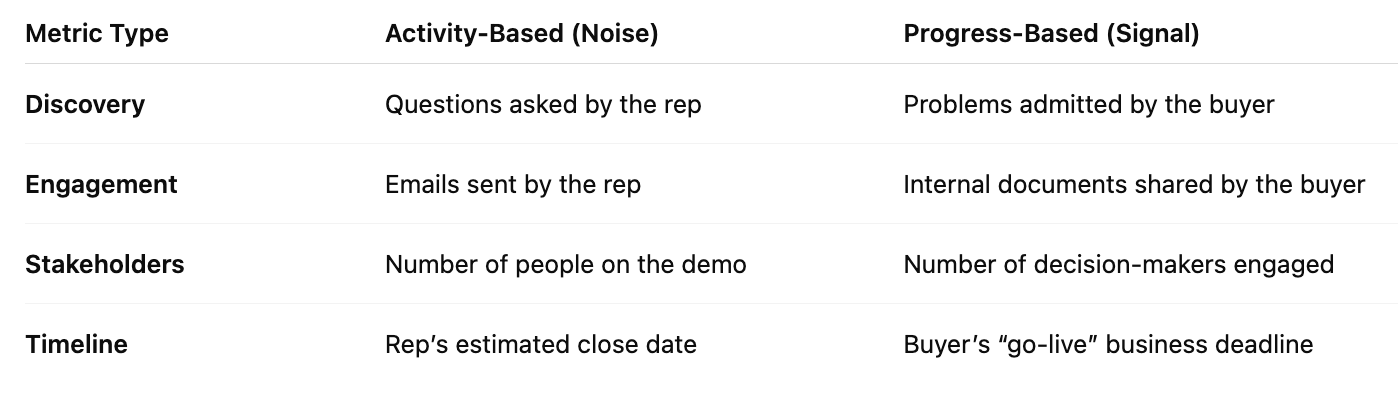
Signal involves asking hard questions like, “If we solve this, who else needs to say yes?”
If you are afraid to ask these questions because you might ‘scare off’ the prospect, you are prioritizing activity over progress. You are protecting a ghost in your pipeline instead of building a business.
Momentum and the CRM: From Graveyard to Guidance System
For most startups, the CRM is a graveyard where deals go to die slowly. It is filled with ‘Stage 2’ opportunities that haven’t been touched in 45 days. This happens because we treat the CRM as a reporting tool for the past rather than a guidance system for the future. To fix this, you must link momentum directly to your CRM stages.
A deal should only move from Discovery to Evaluation if a specific buyer action has occurred. For example, ‘Buyer shared current workflow data’ or ‘Buyer introduced the technical lead.
If you move a deal forward just because you finished the demo, you are lying to yourself and your investors. This is where CRM hygiene becomes a strategic advantage. When your CRM reflects real progress, your forecast becomes a weapon rather than a guess.
HubSpot’s 2025 Sales Trends report highlights that teams using AI to track deal velocity (the speed at which deals move between stages) see a 15% shorter sales cycle. They aren’t just working faster; they are identifying bottlenecks in real-time. If the average deal spends 10 days in ‘Security Review’ but one deal has been there for 30, that is a red flag. It is a loss of momentum. In B2B SaaS, momentum is fragile. Once it stops, the friction required to start it again is often too high to overcome.
Your CRM should answer one question every morning: ‘Which deals actually moved yesterday?
The Professional Visitor vs. The Strategic Partner
There is a specific type of sales rep (and often a specific type of founder) who excels at being a ‘Professional Visitor.
They are likable, they give great presentations, and they build wonderful rapport. Prospects love talking to them. But they never close. Why? Because they are addicted to activity. They mistake a pleasant conversation for a business transaction.
The Strategic Partner, on the other hand, is willing to be slightly provocative. They challenge the buyer’s status quo. They don’t just show features; they map those features to the buyer’s specific business outcomes. They understand that the average B2B deal now involves 6.8 stakeholders, according to 2025 data. They don’t wait for the champion to ‘bring others in.’ They proactively ask to meet the other 5.8 people because they know that without consensus, there is no progress.
Gartner reports that 74% of buying teams experience ‘unhealthy conflict’ during the decision process. The Strategic Partner’s job is to facilitate that conflict and lead the group to a consensus. This is high-level progress. It is messy, it involves difficult conversations, and it doesn’t always look ‘good’ on a weekly activity report. But it is the only way to win in an era where ‘do nothing’ is your biggest competitor.
If you want to move from activity to progress, you must stop acting like a vendor and start acting like a change agent. This means focusing on the buyer’s journey, not your sales process. It means measuring the things that are hard to do, not the things that are easy to track. It means choosing clarity over comfort every single day.
Key Takeaways
Activity is a leading indicator, but progress is the only lagging indicator that matters for revenue growth.
Real progress is defined by buyer actions (sharing data, introducing power) rather than seller tasks (sending emails, doing demos).
A ‘fast no’ is a successful outcome that preserves resources for deals with genuine momentum.
──────────────────────────────────────────────────
Frequently Asked Questions
How can I tell if a demo was actually successful?
A demo is successful only if it results in a defined next step that requires effort from the buyer. If the prospect says ‘this was great, we’ll be in touch,’ it was a failure. If they say ‘can you show this to our VP of Engineering on Thursday?’ it was a success.
Is high sales activity ever a bad thing?
Yes, when it becomes ‘busy work’ that prevents strategic thinking. High activity without progress often leads to burnout and a bloated CRM that makes accurate forecasting impossible.
How many stakeholders are typically involved in a B2B SaaS deal in 2025?
Recent data from 2025 suggests the average B2B buying committee now includes between 6 and 10 stakeholders, depending on the deal size and complexity. Single-threaded deals are significantly more likely to fail.
What is a Mutual Action Plan (MAP)?
A MAP is a shared document between the seller and buyer that outlines the milestones, responsibilities, and deadlines required to reach a purchasing decision. It ensures both parties are aligned on the path forward.
How do I fix a ‘stagnant’ pipeline?
Start by enforcing strict exit criteria for every stage. Audit your ‘Stage 2’ and ‘Stage 3’ deals and disqualify any that haven’t shown buyer-side movement in more than 30 days. Focus your energy on the remaining deals with high velocity.
──────────────────────────────────────────────────
Want to talk through your specific situation? I meet with founders every week.