

For years, the best sales advice in the world could be summarized in one sentence:
Your biggest competitor is “do nothing.”
Deals died because buyers stayed put.
They waited.
They delayed.
They chose comfort over change.
In 2026, that framing is outdated.
Your biggest competitor is not “do nothing.”
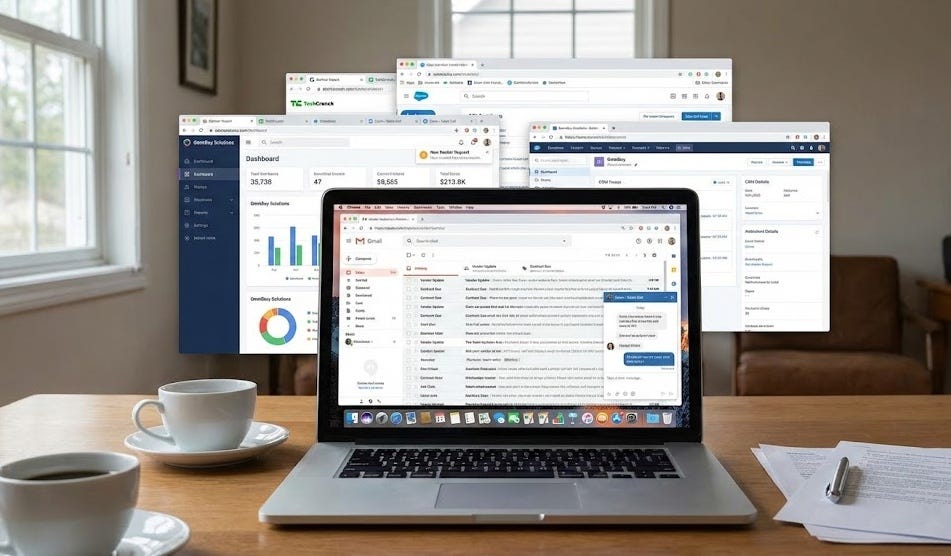
Your biggest competitor is noise.
And if you sell anything that looks remotely like AI, automation, enablement, platforms, agents, or efficiency, you already know this is true.
You are not losing because buyers do not want to act.
You are losing because they do not know who to trust.
Do nothing was passive. Noise is active.

“Do nothing” meant stagnation.
Noise looks like movement.
Buyers are:
taking meetings
running pilots
forwarding vendors internally
asking for decks
comparing options
“aligning with stakeholders”
From the outside, this looks like progress.
Inside the buyer’s head, it is paralysis disguised as productivity.
They are not disengaged.
They are overloaded.
And overloaded people default to the safest possible move.
Not because they are lazy.
Because they are trying not to be wrong.
Why noise is more dangerous than do nothing
When “do nothing” was the enemy, your job was to create urgency.
In 2026, urgency already exists.
Most buyers feel pressure to:
“do something with AI”
“run experiments”
“modernize the stack”
“prove innovation to leadership”
“avoid falling behind”
The problem is not motivation.
The problem is decision confidence.
Noise destroys decision confidence in three ways.
1. Everything sounds the same
Most products are good enough.
Most pitches are polished.
Most demos look impressive.
When buyers cannot tell the difference, they assume there is no difference.
And when there is no perceived difference, the safest move is to wait, expand the evaluation, or choose the incumbent.
Noise does not kill deals loudly.
It quietly erases distinction.
2. Fear of choosing wrong outweighs desire to choose right
In 2026, buying AI feels less like buying software and more like choosing a direction.
Buyers are thinking:
“If this fails, it’s on me.”
“If I choose wrong, we lose a quarter.”
“If this becomes foundational, I better be sure.”
So they hedge.
They add vendors.
They extend pilots.
They increase scrutiny.
They move slower while convincing themselves they are being thorough.
3. Activity replaces intent
Noise creates motion.
Motion creates false confidence on your side.
This is the most dangerous trap for founders and early GTM teams.
You see:
meetings booked
pilots launched
enthusiastic feedback
internal handoffs
And you assume momentum.
But the buyer is not buying.
They are learning.
They are protecting themselves.
They are staying non-committal on purpose.
Noise is not the buyer’s fault
This part matters.
Buyers are not irrational.
They are responding to a market where:
dozens of vendors sound credible
value claims blur together
implementation risk is real
teams are understaffed
attention is fragmented
So they gather more information.
And then they get stuck.
Not because they do not care.
Because caring too much feels risky.
How to sell when the buyer is overwhelmed and cautious
If noise is the enemy, adding more noise will not save you.
More slides.
More features.
More follow-ups.
More “just checking in.”
That does not differentiate you.
It makes you another tab they will never close.
In 2026, winning means reducing complexity, not adding to it.
Make the decision smaller than it feels
Overwhelmed buyers think they are making a permanent choice.
Reframe the decision as:
limited
time-bound
measurable
Not a pilot that “explores possibilities.”
A pilot that answers one specific question.
Bad:
“Let’s see what AI can do for your team.”
Good:
“In 21 days, we will prove whether this removes 30% of inbound load without harming outcomes.”
Clarity creates confidence.
Confidence breaks noise.
Replace value claims with a point of view
Outcomes do not differentiate you anymore.
Everyone promises outcomes.
What differentiates you is helping the buyer make sense of their situation.
A real point of view sounds like:
“Most teams think X is the issue. It’s actually Y.”
“The model isn’t failing. The workflow is.”
“The risk isn’t adoption. It’s internal ownership.”
Noise thrives on sameness.
Insight cuts through it.
Create a one-sentence “why you”
If your buyer cannot explain why you exist in one sentence, you do not have positioning.
And in a noisy market, lack of positioning is fatal.
If they cannot repeat it to their boss, they will not fight for you internally.
Make implementation feel inevitable
Overwhelmed buyers hate hidden work.
Teams are smaller than ever.
The winning pitch is not:
“We have a powerful platform.”
It is:
“We will do the work.”
Reducing internal burden makes you feel safer.
Safety closes deals when the market is loud.
Ask the question others avoid
Noise survives on vagueness.
Clarity kills it.
Ask early:
“What changed to make solving this matter now?”
If they cannot answer, you do not have intent.
You have curiosity.
And curiosity is not pipeline.
The 2026 takeaway
The old playbook was:
Create urgency so they don’t do nothing.
The new playbook is:
Create clarity so they can choose.
Noise rewards the loud.
Revenue rewards the clear.
If your buyer feels overwhelmed, your job is not to persuade harder.
Your job is to make the decision feel obvious, safe, and contained.
That is how deals get done in 2026.